Everyone wants to "use AI." Few organizations are actually ready.
That's not a criticism. It's just reality.
Everyone wants to "use AI." Few organizations are actually ready.
That's not a criticism. It's just reality.
Across agencies are exploring generative AI, automation, machine learning, predictive analytics, and AI-enhanced search. The interest is real. The momentum is real. The pressure from leadership is real.
But here's the uncomfortable question no one is asking out loud: Are you deploying AI, or are you experimenting without structure?
Because those are not the same thing. And in a government environment, the difference matters quite a bit. Wilco Jansen put it well: we may be entering a responsibility phase for AI, and most organizations aren't ready for it.
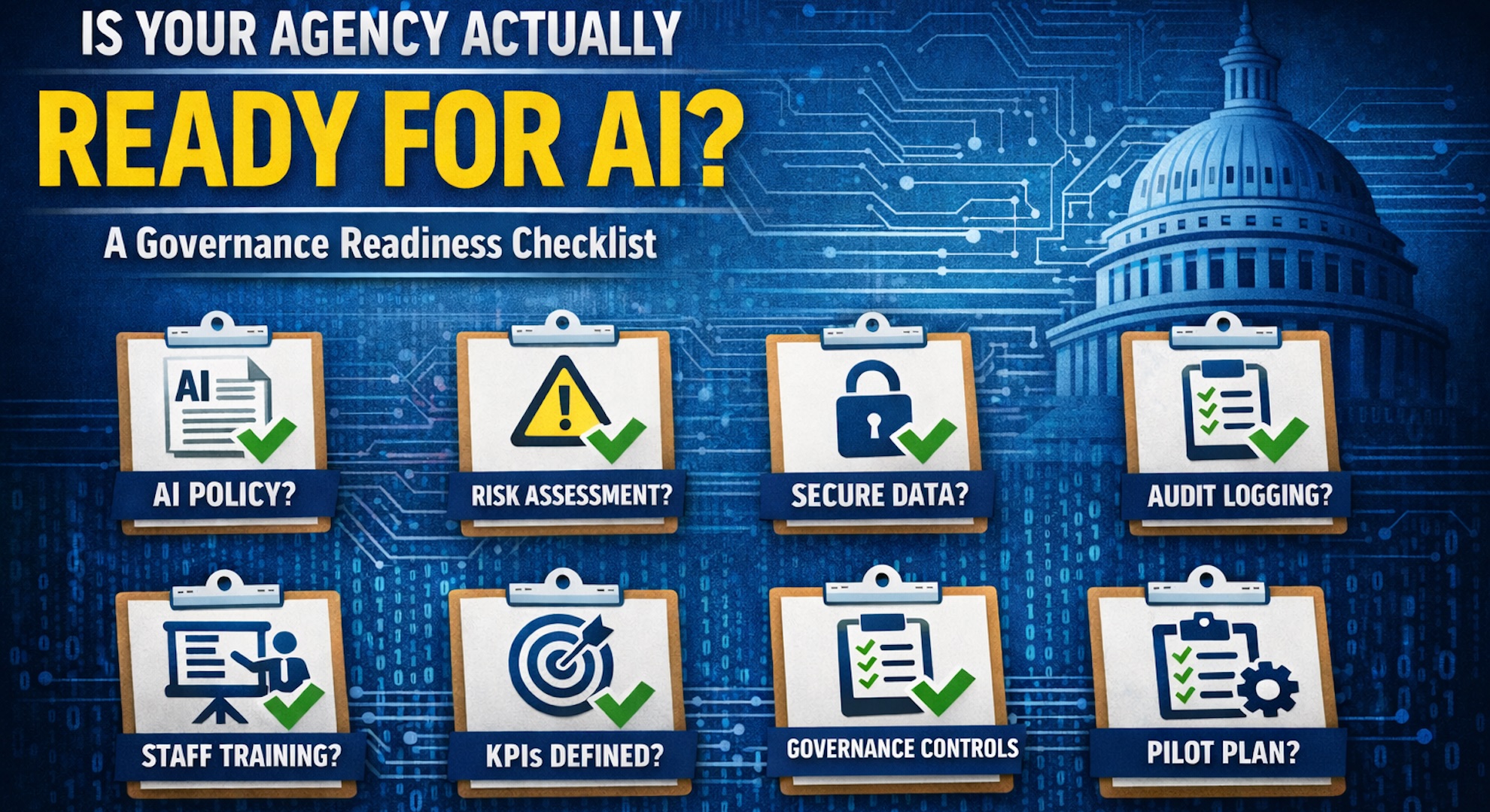
AI readiness isn't about buying the right tools. It's about governance discipline. Let's walk through what that actually means.
The foundation of any responsible AI program is policy, not vague aspirational language about "responsible use," but actual written guidance that tells staff what they can do, what they can't do, and who owns those decisions. If your agency doesn't have an AI use policy yet, that's where this conversation starts. Not with vendors. Not with pilots. With policy.
Governance also means oversight structure: who reviews AI decisions, who has authority to pause a deployment, and what your escalation path looks like when something goes wrong. That last part is easy to skip when everything seems to be going fine. Don't skip it.
Before you can responsibly use AI tools, you need to understand your data environment. Where does your data live? How is it classified? Who can access it, and under what circumstances? AI systems are only as trustworthy as the data they touch, and in government contexts, data security isn't a nice-to-have. It's a legal and regulatory requirement.
Technical readiness also means having infrastructure that can support audit logging. If you can't trace what an AI system did, when, and why, you don't have an auditable system. You have a black box.
Not all AI use cases carry the same risk. Summarizing internal meeting notes is very different from using AI to screen benefits applications or flag security threats. Your agency needs a framework for classifying AI use cases by risk level before deployment, not after something goes sideways.
Low-risk uses can move faster with lighter oversight. High-risk uses need documented review, human-in-the-loop controls, and regular audits. The agencies that treat every use case the same will either move too slowly on things that deserve speed or too fast on things that deserve scrutiny.
Who is responsible for AI deployments day-to-day? If something breaks or produces a bad output, who gets the call? Operational readiness means having clear ownership, defined processes for monitoring deployed systems, and a documented response plan when things don't work as expected. It also means your IT and procurement teams understand how AI tools are being used, not just your communications or innovation leads.
Clear guardrails create responsible use, but guardrails only work if people understand them and believe in the reasons behind them. That means training that goes beyond a one-time awareness session. It means leadership modeling appropriate behavior. And honestly, it means being willing to have the messy conversation about where AI should and shouldn't be used in your specific context, rather than issuing a policy document nobody reads and calling it done.
Staff who understand the "why" behind AI governance are far more likely to flag problems when they see them. That's the cultural asset you're actually building.
Policy without AI training is just a document. Your staff needs to know what your AI policy says, why it exists, and how to apply it to real situations they'll actually encounter. That means role-specific training, not a generic overview deck sent to everyone. The person approving AI-assisted procurement decisions needs different guidance than the person using AI to draft internal communications.
Training also needs to be ongoing. AI tools change fast. A one-time onboarding session from eighteen months ago doesn't cover the tools people are using today.
Government AI use carries a particular ethical weight because the stakes for citizens are high and the power dynamics are not equal. When an AI system influences a government decision about benefits, services, or access, there needs to be a human accountable for that decision. Full stop.
Ethical readiness means your agency has wrestled with questions like: What happens when AI outputs reflect historical bias in training data? How do you ensure transparency with the public about where AI is being used? Who can a citizen appeal to if they believe an AI-assisted decision was wrong? These aren't hypothetical. They're operational requirements.
Pilots are where good governance intentions go to die. An agency launches a "limited pilot" with no success criteria, no end date, no documentation, and no evaluation process, and six months later the pilot is just running. Everywhere. Without anyone making a formal decision to scale it.
A real pilot has a defined scope, a defined timeline, defined success metrics, and a defined decision point. If those four things aren't in place before you start, you're not running a pilot. You're just experimenting and calling it something else.
How will you know if your AI deployment is actually working? Not "it seems useful" working. Measurably working. Before you go live with anything, define what success looks like in concrete terms: processing time reduced by X%, cost per transaction down to Y, error rate below Z. Without defined KPIs, you can't make a defensible case for scaling responsible deployments, and you can't make a defensible case for shutting down irresponsible ones.
Here's the honest version of where your agency stands. If you can answer yes to all of these, you are deploying AI responsibly:
If you can't answer yes to most of those? You're experimenting. And experimentation in government environments carries real consequences for your agency, and for the people you serve.
The agencies that succeed with AI won't be the ones that moved fastest. They'll be the ones that integrated AI into existing governance structures most effectively.
AI doesn't replace governance. It increases the need for it. Innovation inside structure scales. Innovation outside structure destabilizes.
So before your agency asks "what AI tool should we use?" ask this instead: Are we actually ready?