We did not plan this. We did not run a campaign, hire an SEO agency, or engineer some clever technical workaround. We just looked at our search results one day and noticed that Concrete CMS was being cited in Google AI Overviews next to the University of California San Diego, Epic Games, and the Netherlands Cancer Institute.
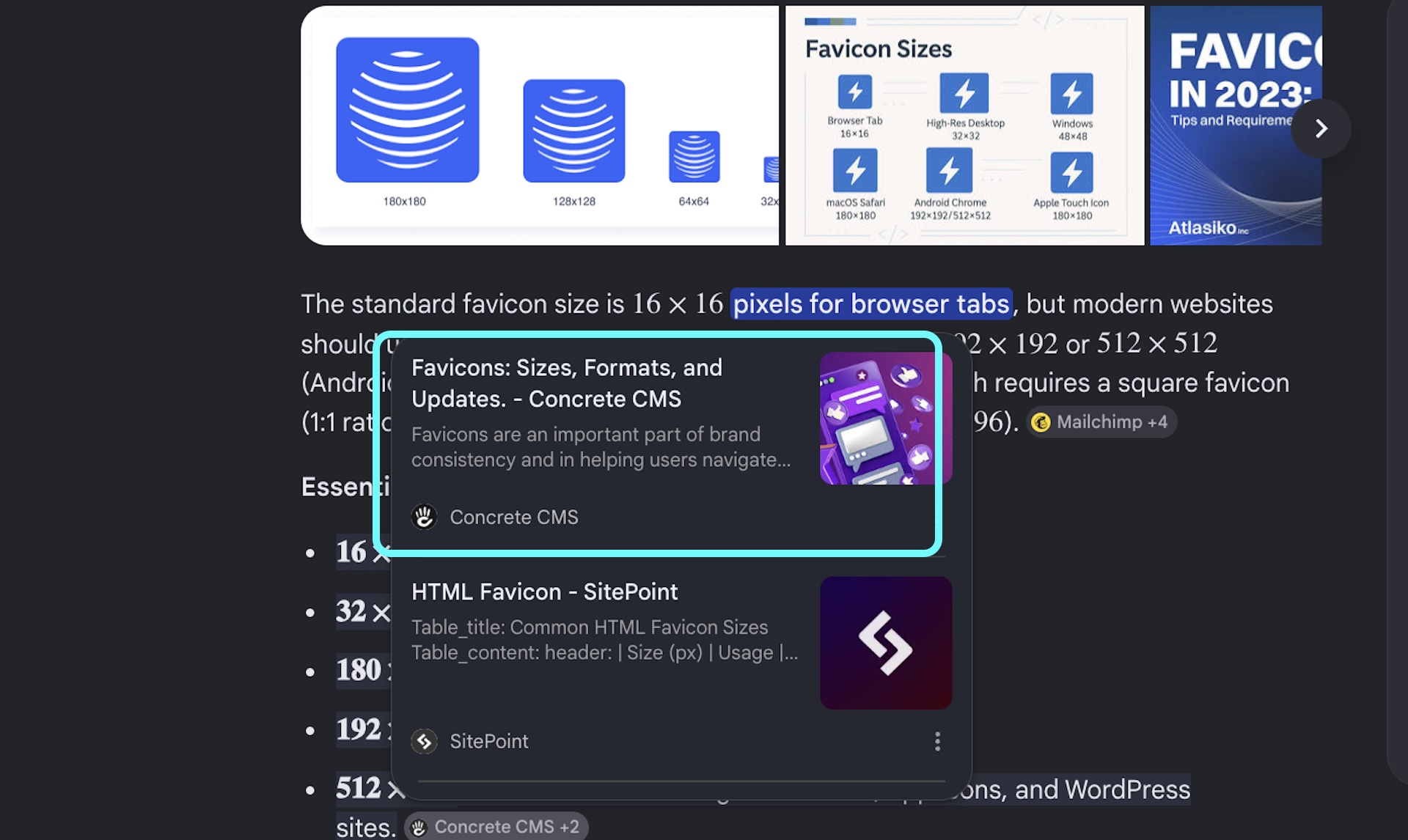
Search "favicon dimensions" and Concrete CMS shows up as a cited source alongside SitePoint.
Concrete CMS cited in Google AI Overview for favicon dimensions search Concrete CMS cited in Google AI Overview for flush DNS search
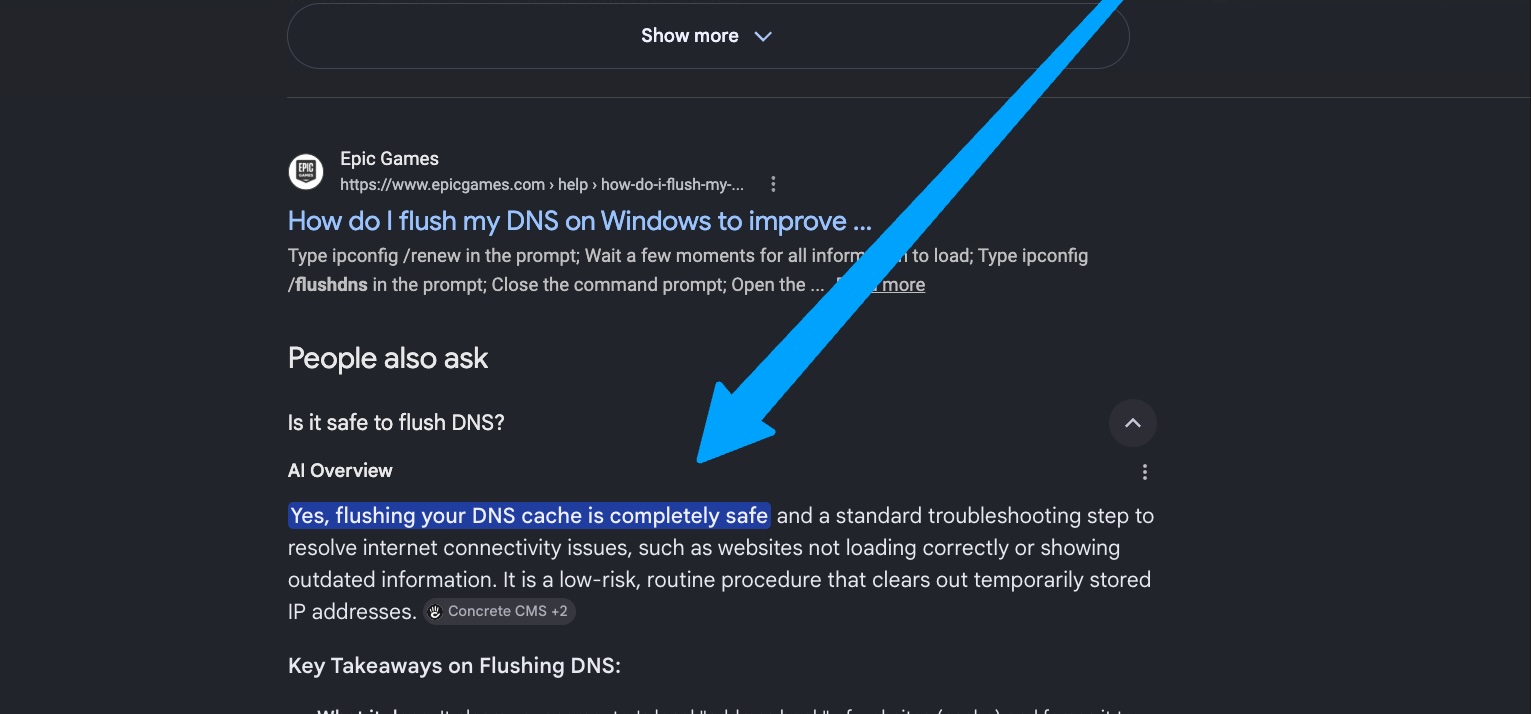
Search "flush DNS" and we appear next to UCSD.
Concrete CMS cited in Google AI Overview for flush DNS search
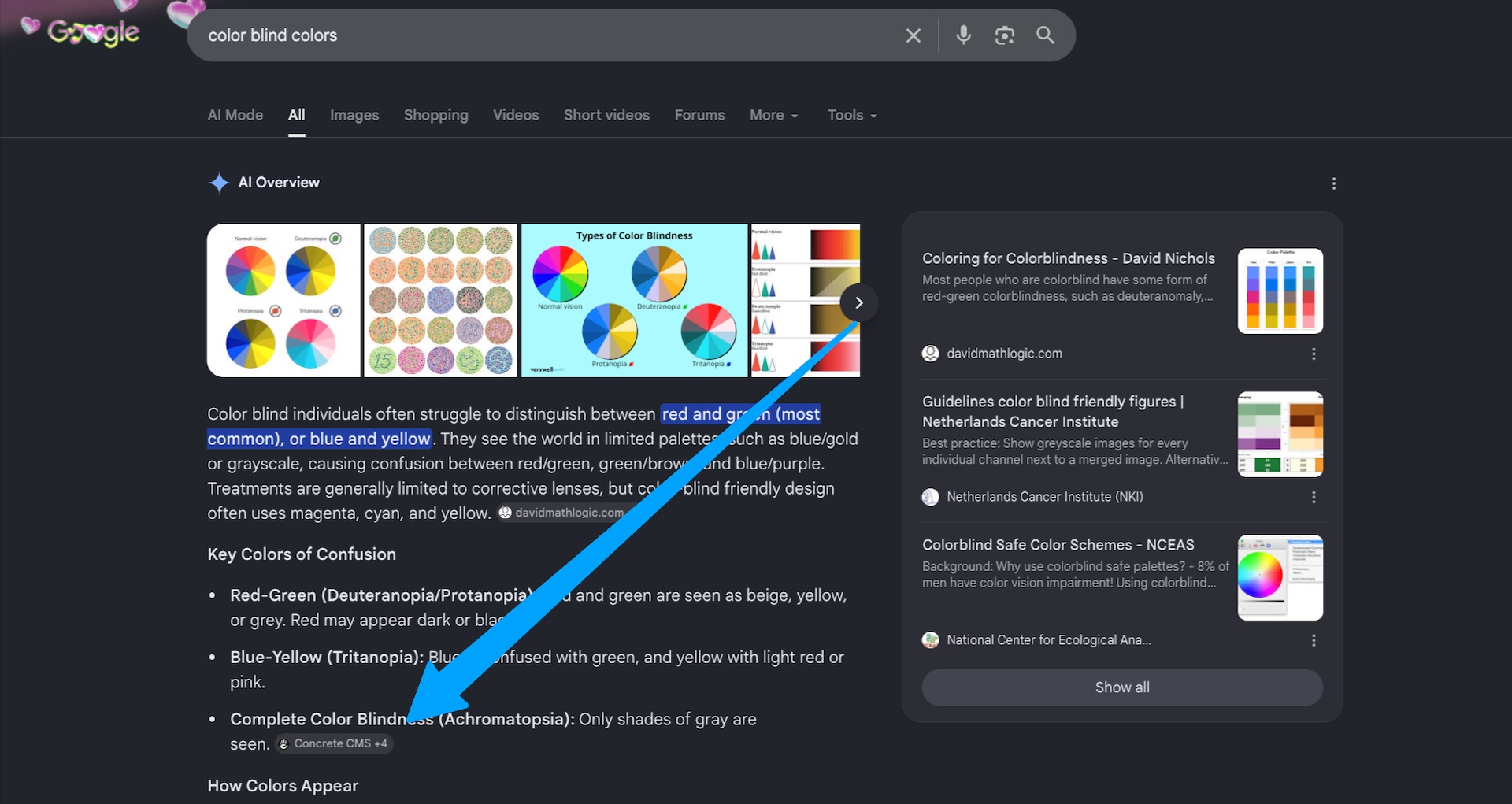
Search "color blind colors" and there we are again, cited alongside the Netherlands Cancer Institute and the National Center for Ecological Analysis.
Concrete CMS cited in Google AI Overview for color blind colors search
That is worth understanding, because the reason it happened is something any website manager can replicate.
What Are Google AI Overviews?
Google AI Overviews are the AI-generated summaries that appear at the top of many Google search results. Instead of just showing a list of links, Google's AI reads multiple sources, synthesizes an answer, and presents it directly on the results page. Each piece of the answer is cited with a source card showing where the information came from.
AI Overviews started rolling out broadly in 2024 and now appear for a significant percentage of searches, particularly for informational and how-to queries. They sit above traditional organic results, which means being cited in one puts you in front of users before they ever scroll to the blue links.
Being featured in a Google AI Overview is not the same as ranking number one in traditional search. You do not need to be the highest-authority site on the topic. You need to have content that the AI can clearly read, trust, and use to answer the question. That is a different bar, and in many cases a more achievable one for well-maintained smaller sites.
Should You Trust Google AI Overviews?
That is a fair question and the honest answer is: mostly, with some caution. Google AI Overviews are generally accurate for factual, well-established topics like technical how-to questions, definitions, and reference information. They pull from multiple sources and cross-reference them, which tends to produce reliable summaries for straightforward queries.
Where they are less reliable is on nuanced topics, recent events, or anything where the source material itself is contested or rapidly changing. Google has iterated on AI Overviews significantly since launch after some high-profile errors in the early rollout, and accuracy has improved. But like any AI-generated content, you should verify anything consequential rather than treating the overview as the final word.
For the kinds of practical, specific questions where Concrete CMS has been cited, favicon sizes, DNS flushing, color blindness, the AI Overviews have been accurate. Those are exactly the kinds of stable, factual topics where the format works well.
What Can Google AI Overviews Do?
From a user perspective, Google AI Overviews can answer questions directly without requiring a click, summarize complex topics in plain language, provide step-by-step instructions, compare options, and surface information from multiple sources in a single synthesized response. For many queries, especially informational ones, users get what they need without ever leaving the search results page.
From a website manager's perspective, AI Overviews do two things worth paying attention to. First, they can drive referral traffic when your site is cited as a source, users can click through to read more. Second, they represent a new kind of search visibility that operates differently from traditional ranking. A page that sits at position seven in traditional search can still be cited in an AI Overview if it has the clearest answer to a specific question.
That second point is why smaller, well-maintained sites like ours can compete with much larger ones.
Is Google AI Overview Free to Use?
Yes. Google AI Overviews appear by default in standard Google Search at no cost to users. You do not need a Google account, a subscription, or any special access. They show up automatically for eligible searches on google.com. Google has also been rolling them out across different regions and languages, though availability varies by market.
For website owners, there is also no cost to appear in AI Overviews. You cannot pay to be cited, and you cannot be penalized for not paying. Inclusion is based entirely on content quality, structure, and trustworthiness signals that Google's AI evaluates when crawling your site.
How to Get Featured in Google AI Overviews
This is the part that actually matters for website managers. Here is what the pattern looks like across every search where Concrete CMS has been cited.
In each case, we had a page that answered a specific question directly, was organized with clear headings, used plain language, and had been maintained well enough that Google trusted it. That is the entire formula. There is no secret technical trick. There is no shortcut. There is just good content, well organized, on a site that Google can read without trouble.
If you want to optimize your content for Google AI Overviews, here is what actually works.
Answer the Question in the First Paragraph
AI systems are looking for the clearest, most direct response to the query. A page that takes 400 words to get to the point will be passed over in favor of one that leads with the answer. State what the page is about and answer the core question before you do anything else.
Use Descriptive, Logical Headings
H1, H2, and H3 tags tell AI crawlers how your content is organized and what each section is about. A page with logical, descriptive headings is dramatically easier for an AI to parse than a wall of text. Use headings that describe what the section answers, not just decorative labels.
Write for Specific Questions, Not Broad Topics
The searches where we showed up were specific. "Favicon dimensions" is more specific than "web design tips." The more precisely your content matches the actual question someone is asking, the better your chances of being cited in the answer. Think about the exact phrasing someone would type into Google and write content that matches it.
Keep Content Current
Stale content is a trust signal in the wrong direction. A page that has not been updated in years, especially on a topic where information changes, tells Google the site may not be reliable. Even a small review and update with a current date signals that the page is being maintained.
Build Clear Authorship Signals
Author names, publication dates, and update dates all contribute to trustworthiness. A page that clearly says who wrote it and when is more credible to an AI than an anonymous, undated page. These signals matter more now than they did two years ago.
Make Sure Your Site Is Crawlable
None of the above matters if Google cannot access your pages. Check your robots.txt, make sure important pages are not accidentally blocked, keep your sitemap current, and make sure your page load times are reasonable. Basic technical hygiene is a prerequisite for everything else.
Why Your CMS Is Part of This Equation
Here is where we will be direct, because our own experience is relevant.
The reason Concrete CMS shows up in AI Overviews for topics like favicon dimensions and color blindness is not luck. It is because PortlandLabs has used Concrete CMS to maintain a blog with clear authorship, consistent structure, proper heading hierarchy, and content that gets updated rather than abandoned. The platform made it easy to maintain those standards across a lot of pages over a long period of time.
Concrete ships with permissions and workflow tools built into the core. That means you can define who owns which content, require review before anything goes live, and enforce the kind of content governance that keeps a site trustworthy over time. You are not relying on everyone remembering to do the right thing. The system supports the process.
For AI search specifically, that matters because Google is not just evaluating individual pages in isolation. It is evaluating the overall trustworthiness and consistency of your site. A well-governed site with clear ownership and regular maintenance looks very different to an AI crawling it than a site where anyone can publish anything and nothing ever gets reviewed.
The content strategy and the CMS are not separate conversations. The platform you use to manage content either makes good governance easy or it makes it hard. That difference shows up in search.
Getting your content AI-ready also means thinking about how you create it in the first place. If you want to go deeper on how to get better output from AI writing tools, we wrote about that too. The interview method for prompting AI is one of the most practical changes a content team can make right now.
The Bigger Picture
For the last decade, the dominant content strategy was about volume. Publish more, target more keywords, build more links. That approach still has its place, but AI search is shifting the balance toward quality, specificity, and trust.
A small, well-maintained site with clear content and good governance can genuinely compete with much larger organizations for visibility in Google AI Overviews. We know because we are doing it. You do not need a bigger budget. You need better content and a system that helps you keep it that way.