If you want to understand where AI is today, you don’t have to start in a research lab or a boardroom. Sometimes the clearest signals come from the internet itself.
If you want to understand where AI is today, you don’t have to start in a research lab or a boardroom. Sometimes the clearest signals come from the internet itself.
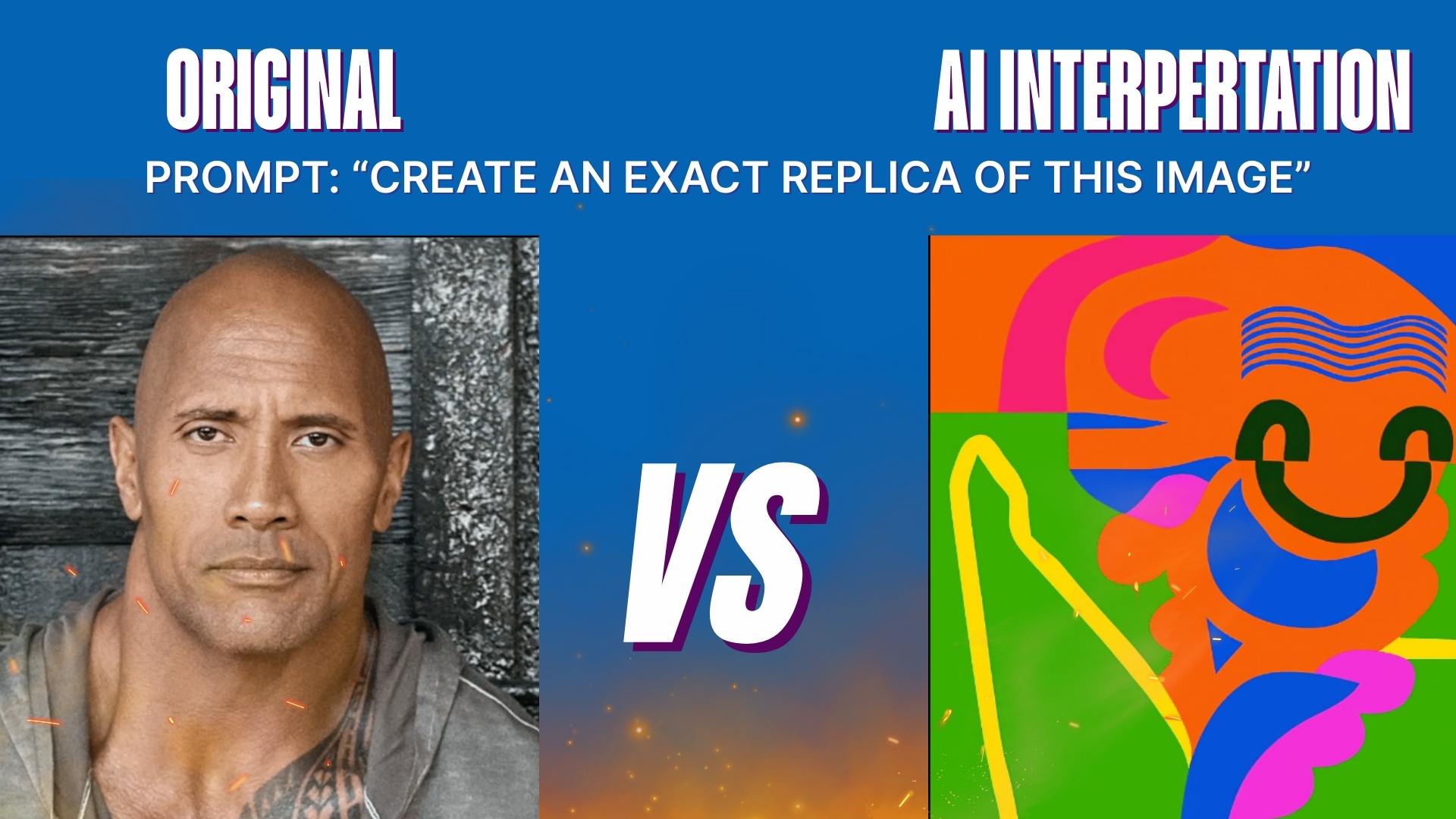
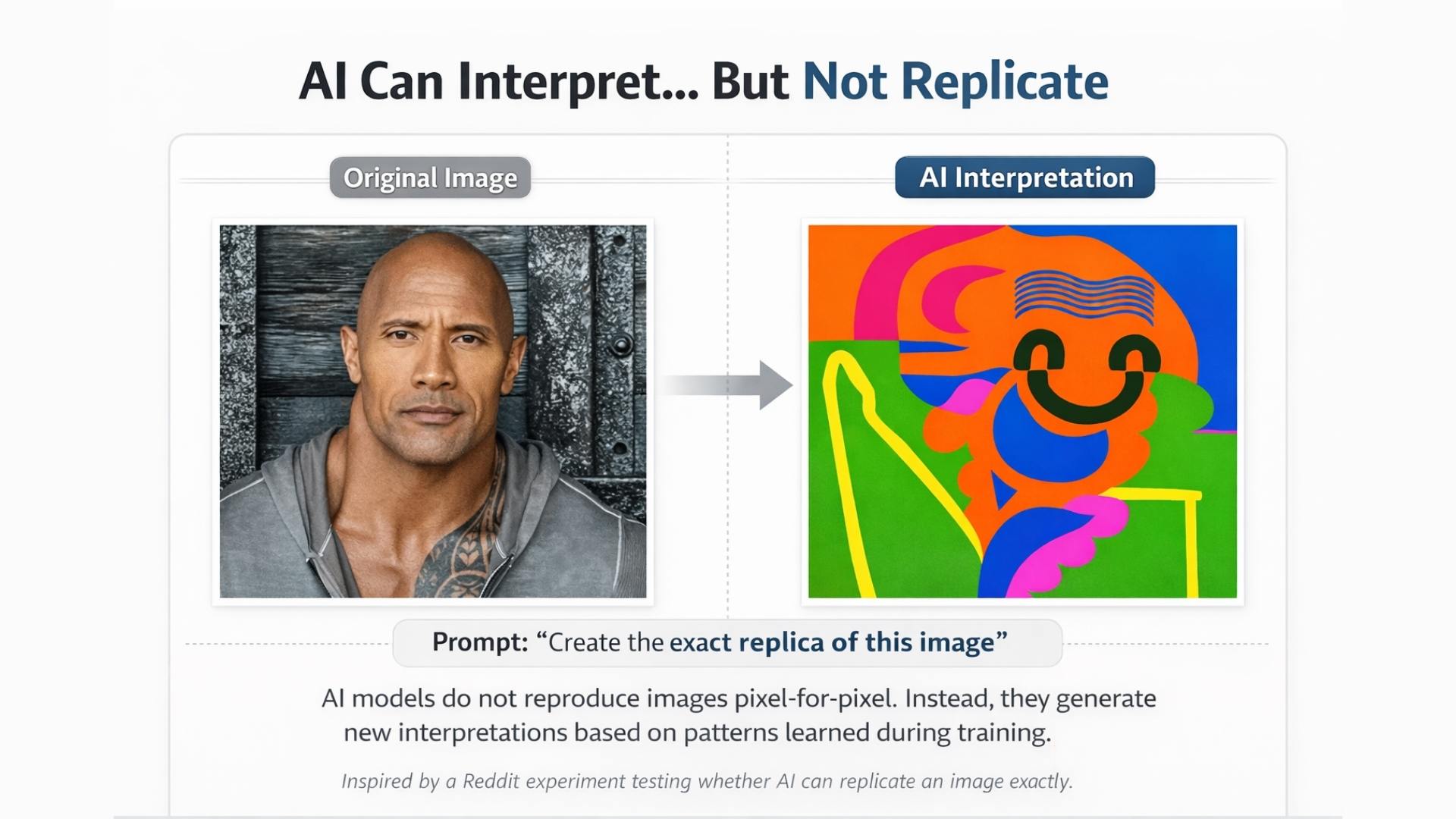
A few months ago, a Reddit post made the rounds where someone tried to get an AI model to create an exact replica of an image of Dwayne “The Rock” Johnson. The idea seemed simple: show the model the image and ask it to reproduce it exactly.
But what happened next revealed something deeper.
Instead of producing a perfect copy, the AI generated variations. Similar pose, similar structure, recognizable elements but never a perfect replica. The thread quickly filled with people experimenting, debating, and pushing the model to see where the boundaries actually were.
You can still see the discussion here:
https://www.reddit.com/r/ChatGPT/comments/1kbj71z/i_tried_the_create_the_exact_replica_of_this
It might seem like a small internet curiosity, but moments like this capture something important about the current era of AI. We’re collectively probing the edges of what these systems can and cannot do.
And while the public experiments on Reddit, businesses have been running their own experiments behind the scenes.
The results haven’t always been encouraging.
According to research cited by MIT and industry reports, as many as 90% of AI projects fail to make it into production or deliver meaningful business value.
as many as 90% of AI projects fail to make it into production or deliver meaningful business value.
MLQ.ai. (2025).
State of AI in Business 2025 Report.
That number surprises people at first. After all, AI is everywhere product launches, startup funding, boardroom strategies, and innovation roadmaps. But when you step back and look at the past few years, the pattern becomes clearer.
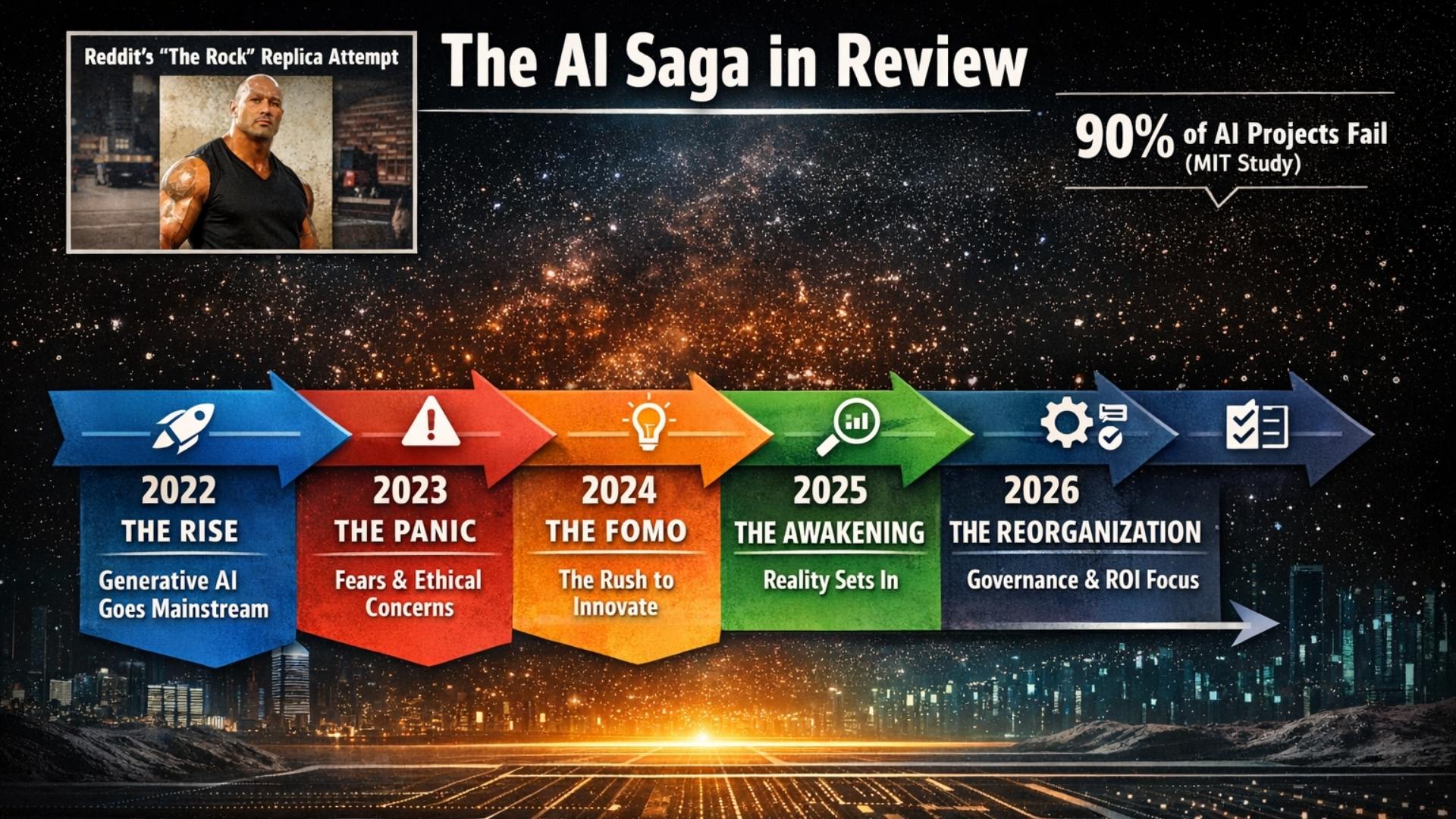
The last few years of AI development have followed a recognizable cycle.
The AI Saga in Review
2022: The Rise
AI models suddenly became accessible to the public. Generative AI tools exploded into everyday use. For the first time, people could interact directly with machine intelligence in real time.
2023: The Panic
The conversation shifted almost overnight. Headlines asked whether AI would replace jobs, disrupt industries, or flood the internet with misinformation. Organizations rushed to understand the risks.
2024: The FOMO Phase
If your company didn’t have an AI strategy, it felt like you were already behind. Innovation budgets appeared everywhere. Teams started experimenting with pilots, prototypes, and proof-of-concept tools.
But this is where many organizations got stuck.
Instead of building systems that delivered value, they found themselves running on what looked like an innovation hamster wheel. New tools were tested constantly, but very few made it into production.
2025: The Awakening
Organizations started realizing something important: AI itself wasn’t the hard part. The real challenges were data quality, governance, adoption, and strategy.
It wasn’t enough to deploy a model and hope for transformation.
Companies had to ask harder questions:
- What is the actual outcome we want?
- What problem are we solving?
- How will we measure impact?
2026: The Reorganization
This year is starting to look less like experimentation and more like reorganization and governance.
Companies are forming AI task teams. Leadership is asking for hard ROI instead of flashy demos. Organizations are beginning to treat AI less like a novelty and more like infrastructure.
In other words, the saga is moving into its next chapter.
The question is no longer what AI can do.
The real question is:
How do we make AI practical?
Sources
- MLQ.ai. (2025). State of AI in Business 2025 Report.
https://mlq.ai/media/quarterly_decks/v0.1_State_of_AI_in_Business_2025_Report.pdf - u/whoknowswhy2025. (2025). I tried the “create the exact replica of this image” [Online forum post]. Reddit.
https://www.reddit.com/r/ChatGPT/comments/1kbj71z/i_tried_the_create_the_exact_replica_of_this/